Research
By Bill Clayton
Magic Bus -- Development of a GPS Tracking System for U-M Transportation Services
RIDERSHIP ON PUBLIC TRANSPORTATION has increased 22 percent in the last six years - about 14 million Americans ride on public transportation each weekday. The increasing appeal of public transportation is attracting the attention of engineers who see the need to make bus systems more efficient to improve the commuting experience. University of Michigan Transportation Services (UMTS) has the same ultimate objective: to improve the experience of riders on its bus system.
The Optimization of "Invisible" Complex Systems
The systems that regulate traffic, the military, manufacturing and other movable parts of everyday life are vital - to peoples' lives, to the economy and to the health and safety of the planet. Robert Smith, Altarum/ERIM Russell D. O'Neal Professor of Engineering, Associate Professor Marina Epelman and graduate student, Shih-Fen Cheng, all from Industrial and Operations Engineering, are examining ways to improve these "invisible" systems.
Distributed Optimal Technology Networks: a Concept and Strategy for Potable Water Sustainability
THROUGHOUT HISTORY, THE contamination of a nation's water supply has been a strategic objective in armed conflict. Despite those and many other warnings, the United States today has 54,065 public and private water systems, and no adequate way to protect them from either of two types of sabotage - vandalism, which interrupts the supply of water and reduces its quantity, and terrorism, which contaminates the water and reduces its quality.Walt Weber is responding to this problem with the development of the "distributed optimal technology network"(DOT-NET) concept.
An Environmental Monitoring Network for Lake St. Clair
Despite the importance of inland waterways to health, economy, recreation and culture, municipalities have done little to protect this resource - and the events of 9/11 have made this oversight all the more critical. However, Guy Meadows, a professor in the Department of Naval Architecture and Marine Engineering, leads a team that developed, tested and completed a fully-operational environmental forecasting system that will help cities and towns solve the critical problems that plague inland waterways.
Identification and Interdiction of Illicit Nuclear Materials
Zhong He, an associate professor in the Department of Nuclear Engineering and Radiological Sciences, and his team are developing semiconductor-based gamma-ray imaging spectrometers with multiple applications, including the detection and identification of nuclear materials. This, in turn, will mitigate nuclear proliferation and the potential for nuclear terrorist attacks. That is, it's research that has the potential to save lives and property and ease international tensions.
Information Integration
To sift through such vast amounts of information and find the "needles in a haystack" that might be signs of terrorist acts in the making, a system must interconnect data sets - often seemingly unrelated - to reveal patterns, make predictive analyses and come to actionable conclusions on a real-time basis. The system must also enable different agencies to share and access critical information at key decision points. H.V. Jagadish, a professor in the Department of Electrical Engineering and Computer Science, is working to develop such a system.
Magic Bus - Development of a GPS Tracking System for U-M Transportation Services
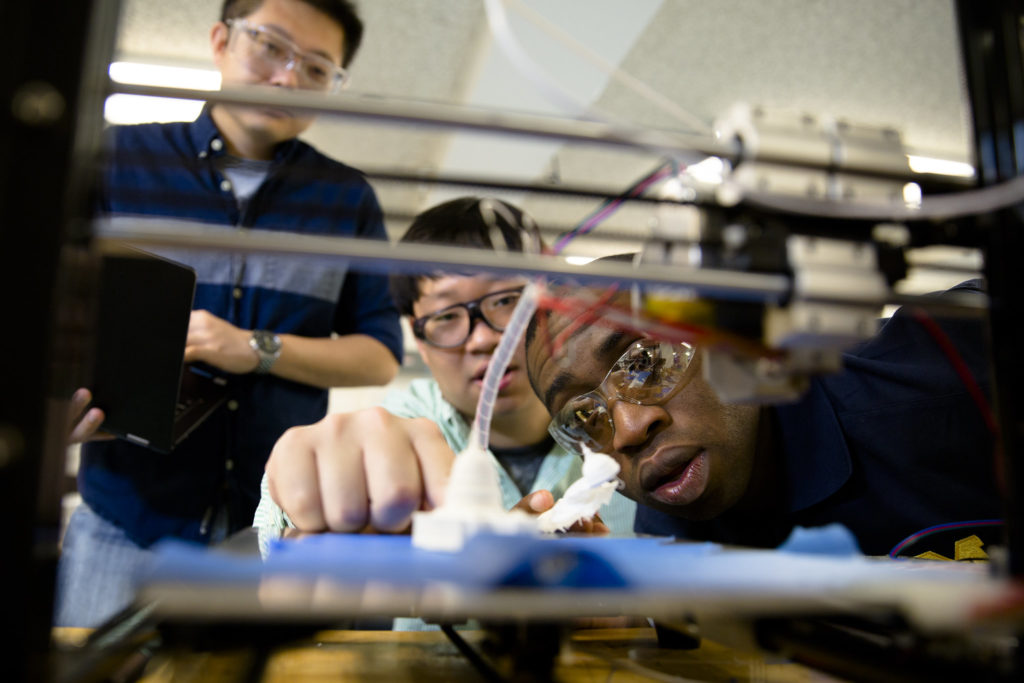
(left) Professor Ruf (c) and undergraduates David Harris (l) and Gustavo Tepedino (r) check components of device.
(right) Graduate student Marc Allen positions prototype GPS device in compartment above and behind driver.
PHOTOS BY LIN JONES
RIDERSHIP ON PUBLIC TRANSPORTATION has increased 22 percent in the last six years - about 14 million Americans ride on public transportation each weekday. The increasing appeal of public transportation is attracting the attention of engineers who see the need to make bus systems more efficient to improve the commuting experience. University of Michigan Transportation Services (UMTS) has the same ultimate objective: to improve the experience of riders on its bus system.
Chris Ruf, a professor in the departments of Atmospheric, Oceanic and Space Sciences, and Electrical Engineering and Computer Science, took on the challenge of developing a system that keeps track of campus buses, letting riders know where buses are and when to expect them at bus stops. It's a complex problem in navigation, scheduling and communication. Ruf also saw it as a learning opportunity - he turned the "Magic Bus" project into a directed-study program in which freshman through senior level student researchers designed, built and field-tested a system for UMTS buses.
"In their research," Ruf said, "the students investigated numerous factors: radio telemetry; wireless Internet communications; mechanical and electrical interfaces to bus power, display screens and engine diagnostics; database and web-hosting software to disseminate the information; and a tracking system using the Global Positioning System, or GPS, which is a worldwide radio-navigation system that's based on 24 satellites operated by the U.S. Department of Defense."
Ruf added that the team is currently installing prototypes on U-M buses. "The wireless system links GPS receivers on each bus, through a U-M database server, to the Magic Bus website. UMTS administrators can also access the data to monitor bus locations, route IDs and engine health." The Magic Bus project will enable UMTS to provide concise schedules and equip bus stands with monitors that display the real-time locations of buses, their on-time status and whatever time variances there might be. Results from the Magic Bus project could have applications for municipal bus lines. -E
Program funded by University of Michigan Transportation Services.
The Optimization of "Invisible" Complex Systems
|
IOE's Professor Robert Smith, graduate student Shih-Fen Cheng and Associate Professor Marina Epelman talk over a computer simulation. |
TRAFFIC CONGESTION DOES MORE than make drivers curse under their breath. In 1997, it cost Americans an estimated $72 billion in wasted fuel and lost wages due to late arrivals at work - an average of $900 per driver. Congestion also contributes to excessive carbon monoxide emissions, a shorter lifespan for vehicles, road rage, heart attacks and stroke.
Similar problems with movement affect the military - the inefficient transport of supplies can put troops in great danger during warfare. For industry, inefficient manufacturing systems diminish quality, delay deliveries and create stocking problems that damage bottom lines.
The systems that regulate traffic, the military, manufacturing and other movable parts of everyday life are vital - to peoples' lives, to the economy and to the health and safety of the planet.
Robert Smith, Altarum/ERIM Russell D. O'Neal Professor of Engineering, Associate Professor Marina Epelman and graduate student, Shih-Fen Cheng, all from Industrial and Operations Engineering, are examining ways to improve these "invisible" systems. "They're so complex," Smith said, "that it's necessary to create computer simulation models to conduct studies and build the decision- making software that can design and regulate them efficiently and effectively.
"In our work on traffic congestion, sponsored by the Operations Research Program of the National Science Foundation, we used models to study real-time congestion and create software that computes routes which offer faster trip times. The new system is intuitive and would enable drivers to 'discover' these routes automatically - this is particularly important in the presence of incidents such as traffic accidents when real-time information can reduce delays dramatically. We've simulated what would happen were such a system employed for traffic in Troy, Michigan, and it significantly reduced average travel times."
Many of the same ideas are being employed in an Office of Naval Research sponsored project for the routing of naval warships on the high seas.
The success of this program can decrease consumption of fuel, pollution, wear and tear on vehicles, the stress on individuals, the potential for road rage, heat stroke and heart attack. In short, these programs - applied to many different kinds of systems - have the potential to save lives, protect property, improve business and support national security. -E
Major funding for this research has come from the Operations Research Program of the National Science Foundation and an Office of Naval Research MURI Grant.
Distributed Optimal Technology Networks: a Concept and Strategy for Potable Water Sustainability
|
Walt Weber and his work made the cover of the November 15, 2004, Environmental. |
THROUGHOUT HISTORY, THE contamination of a nation's water supply has been a strategic objective in armed conflict. During World War II, the Nazis used raw sewage to poison reservoirs. Before the attack on Pearl Harbor, J. Edgar Hoover noted that an enemy could easily attack the nation's water supply. In Kosovo, armies dumped dead animals into wells. In 2002, the FBI detected al-Qaeda operatives researching data on the web with a particular interest in water supply and wastewater management.
Despite those and many other warnings, the United States today has 54,065 public and private water systems, and no adequate way to protect them from either of two types of sabotage - vandalism, which interrupts the supply of water and reduces its quantity, and terrorism, which contaminates the water and reduces its quality.
Worldwide, drinking-water supply systems treat water at centralized treatment facilities, then distribute the water to users. A major drawback to these systems is that they leave raw-water ponds and pipelines poorly protected and open to contamination throughout the distribution system. Walt Weber is responding to this problem with the development of the "distributed optimal technology network" (DOT-NET) concept. Weber is the Gordon M. Fair and Earnest Boyce Distinguished University Professor of Environmental Science and Engineering, and has appointments in Chemical Engineering and in Civil and Environmental Engineering.
He explained that the concept "provides for placing high-tech satellite units in strategic locations within water distribution systems to re-treat water for direct human consumption. One such unit developed for in-home use has been demonstrated to destroy spores such as anthrax within a few minutes. The concept leverages existing centralized treatment and distribution infrastructures, significantly reducing costs for its implementation."
DOT-NET is a flexible, responsive system that will provide and protect high-quality, affordable potable water in an age when bioterrorism is a harsh reality, and large-scale disasters are an ever-present possibility. DOTNET addresses problems that have existed for centuries but have never received the attention they deserve - until now. -E
Program supported in major part by a research grant from the National Water Research Institute.
An Environmental Monitoring Network for Lake St. Clair
OLD TIMERS WHO'VE WATCHED the decline of various inland waterways like to say that the fish are "dying to get out." Their wit has some sad truth in it. Since 1990, the combined sewage overflow into the Lake St. Clair system totals more than 15.3 billion gallons. And the number of water-quality monitoring stations in the Lake St. Clair-Detroit River system has decreased more than 70 percent over 20 years. Yet about six million people in southeast Michigan get their drinking water from treatment plants along the lake and the Detroit River. And of all fish caught in the Great Lakes, 33 percent are taken from Lake St. Clair.
Despite the importance of inland waterways to health, economy, recreation and culture, municipalities have done little to protect this resource - and the events of 9/11 have made this oversight all the more critical. However, Guy Meadows, a professor in the Department of Naval Architecture and Marine Engineering, leads a team that developed, tested and completed a fully-operational environmental forecasting system that will help cities and towns solve the critical problems that plague inland waterways.
Boaters are accustomed to seeing Meadows bobbing in the
cold waters of Grand Traverse Bay as he checks the
instrumentation on an environmental monitoring buoy.
PHOTO BY DAVE SPECKMAN, DON RUTT PHOTOGRAPHY
Meadows said that he and his team "created a two-dimensional, high-resolution hydrodynamic numerical model that's able to predict circulation patterns throughout the Lake St. Clair system. Remote sensors can collect realtime meteorological and environmental data from across the lake's basin and the surrounding watershed. Given this rich data, the numerical model can predict the real-time distribution patterns for contaminants."
In creating the model, researchers also developed a delivery system that makes the model's forecasts available, accessible and easy to use so that decision-makers can act quickly and decisively.
Meadows moved the project to Michigan's Grand Traverse Bay, which offers new challenges. "We launched an environmental monitoring buoy," Meadows said. "It's giving us real-time measurements every ten minutes and sends them directly to the web so anyone can access the information." The model is a robust, predictive tool that will help municipalities address the detrimental effects of a degraded water supply and the very real threat of bioterrorism. -E
Program funded by Michigan Sea Grant and the local communities surrounding Lake St. Clair (U.S. side only).
Identification and Interdiction of Illicit Nuclear Materials

IN 1994, LOUIS FREEH, then director of the FBI, said that the smuggling of nuclear materials is the "greatest long-term threat to the security of the United States." In 1996, an anonymous Russian source noted that accounting procedures at the nearly 100 nuclear storage facilities in the former Soviet Union were so poor that authorities might not discover a missing warhead for as long as six months.
That same year, John Deutch, then director of the CIA, told a Senate subcommittee that "nuclear materials and technologies are more accessible now than at any time in history."
ILLUSTRATION BY JILL OSTROWSKI
Today, almost ten years later, the world lives in fearful anticipation of terrorist attacks, and nuclear materials are among the most serious of all threats to homeland security - these weapons take the form of nuclear explosives or "dirty bombs" that are designed to spread radioactive contamination over a wide area. National security is at stake. Yet, despite the importance of detecting signals from specific nuclear materials (SNM) at key locations, such as border crossings, transportation centers and shipping ports, the technology to do so is woefully inept.
Zhong He, an associate professor in the Department of Nuclear Engineering and Radiological Sciences, explained that the radioactive emissions from SNM "are relatively weak, but are the most direct signatures of the presence of these materials. So, we're developing semiconductor-based gamma-ray imaging spectrometers based on a 3D position-sensing technology. This technique makes the detector an excellent Compton imaging device with unprecedented spatial resolution, energy resolution and compactness, and with the ability to operate at room temperatures." (A Compton imaging device is based on detecting a sequential interaction of the emitted gamma rays with the position- and energy-sensitive detectors.)
The work will have multiple applications, including the detection and identification of nuclear materials. This, in turn, will mitigate nuclear proliferation and the potential for nuclear terrorist attacks. That is, it's research that has the potential to save lives and property and ease international tensions. -E
Program supported by DOE/NNSA NA-22 Office and DOD Defense Threat Reduction Agency.
Information Integration
ON ANY SINGLE DAY, federal, state and local law-enforcement agencies might generate the equivalent of hundreds of millions of pages of reports containing data relevant to the more than one million people who pass through U.S. ports of entry; the 30,000 trucks and 6,000 rail cars that pass into the U.S.; the 150 ships from 7,500 foreign registries that make port somewhere in the U.S.; and the thousands of gigabytes of sophisticated data that flow in from alternate sources.
To sift through such vast amounts of information and find the "needles in a haystack" that might be signs of terrorist acts in the making, a system must interconnect data sets - often seemingly unrelated - to reveal patterns, make predictive analyses and come to actionable conclusions on a real-time basis. The system must also enable different agencies to share and access critical information at key decision points.
To date, no single system can do all of that, much less do it quickly. But H.V. Jagadish, a professor in the Department of Electrical Engineering and Computer Science, is working to develop just such a system.
LUSTRATION BY DANIEL PARROTT
H.V. Jagadish's method of information integration has many potential applications, one of which is the analysis and understanding of the volumes of data related to breast cancer.
The research focuses on a high-performance database system based on XML (Extensible Markup Language), a simple, flexible language that enables information to be transferred from one database to another. Jagadish explained: "Beyond merely transferring information, this research develops a process of deep integration that enables piecing together larger facts from fragments in each source while keeping track of how each such composite fact was derived."
A database system based on this approach could help detect an impending terrorist threat, or help to mount an effective response to such an act. For example, determining the number of people likely to be affected by a pathogen released in a chemical attack will require knowledge of local topography, wind conditions and population densities, each of which has to be obtained from a different data source and then integrated to solve the problem at hand. Additional information on hospital capabilities and transport capacities must also be integrated to determine the most effective response. This work has the potential to save lives on a global scale, prevent war initiated by terrorist activity, and protect property and investments. -E
Program supported by the National Science Foundation and the National Institutes of Health.
Help Recruit the Best and Brightest
To volunteer for this rewarding interaction with students, email engin.alumni.relations@umich.edu or call 734-647-7042.
Our alumni personify the best of Michigan Engineering - they're the ideal people to speak with those who need and want direction. Each year about 75 alumni call top scholars to encourage them to choose Michigan Engineering - it's an exceptional program that the College and the Engineering Alumni Society want to maintain and improve.