

Advanced Manufacturing
Reinventing U.S. manufacturing for resilience and scale
From the Midwest’s high-tech hub and the nation’s industrial heart, University of Michigan Engineering is leading research, education and industry collaboration to reinvent how America designs, makes and scales advanced technologies.
We’re working to deliver on the promise of Industry 4.0, develop partnerships to advance Industry 5.0, and pioneer efforts to define Industry 6.0 and beyond. Our efforts align with federal priorities to develop resilient supply chains, strengthen national competitiveness and protect national security.
Michigan Engineering’s unparalleled breadth and state-of-the-art facilities are part of an expansive manufacturing R&D and workforce ecosystem that bridges the gaps between design, lab-bench and industrial-scale. We have world-class expertise in mechanical, industrial, and biomedical engineering as well as robotics, materials science, naval architecture and more. Across campus, we collaborate with other leading U-M programs such as business and medicine. Our Battery Lab hosts the nation’s highest-capacity university-based pilot line. Through our new U-M Advanced Manufacturing Institute, we’re integrating these strengths to pioneer a modernized model for manufacturing innovation and impact. Through our new U-M Advanced Manufacturing Institute, we’re integrating these strengths to pioneer a modernized model for manufacturing innovation and impact.
Top 10 in manufacturing-related 2026 US rankings
Mechanical engineering (#6)
Robotics (#7, only US R1 with dedicated department)
Materials science (#7)
Industrial engineering (#2)
Biomedical engineering (#6)
Sources: Robotics ranking ’16-’26 from roboranking, which measures publications. Others 2026 USN&WR specialty rankings.
Today we’re unlocking the potential of 3D printing with design-for-additive manufacturing approaches and new additive manufacturing process technologies. We’re deepening integration of AI, robotics and computational science to streamline smart factories and supply chains. We’re expanding human capabilities—honing ergonomics and human-autonomy systems as we work toward a ‘cognitive manufacturing’ future where specialized, adaptive AI teammates act as partners and can lead in decision making.
250K students
trained through the LIFT Manufacturing USA institute that U-M co-founded in 2015.
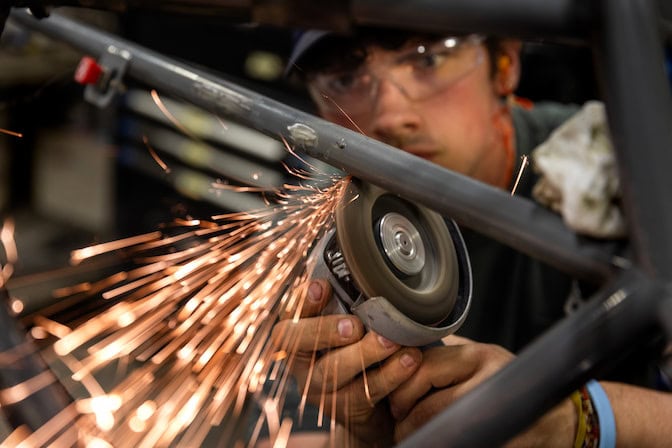
Pairing students with small & mid-sized manufacturers benefits both
A new fellowship program gives students industry experience in the small and mid-sized manufacturing companies that make up 98% of the sector.
Technology for tomorrow’s smart manufacturing
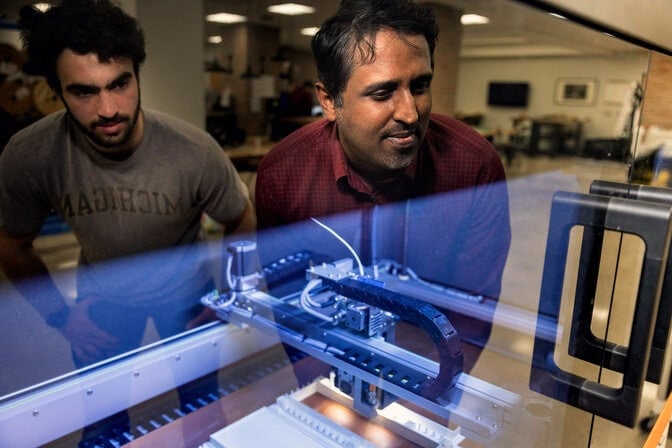
3D printing & additive manufacturing
Unlocking 3D printing’s potential via design-for-additive, optimized processes & materials
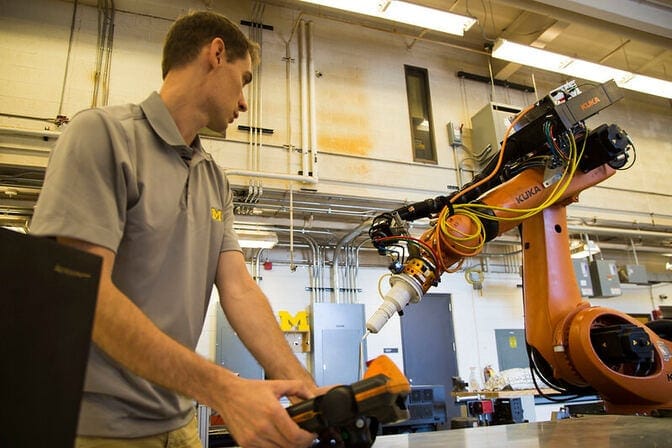
Robotics and automation
Advancing control systems, autonomous agents & safe integration of robotics in production
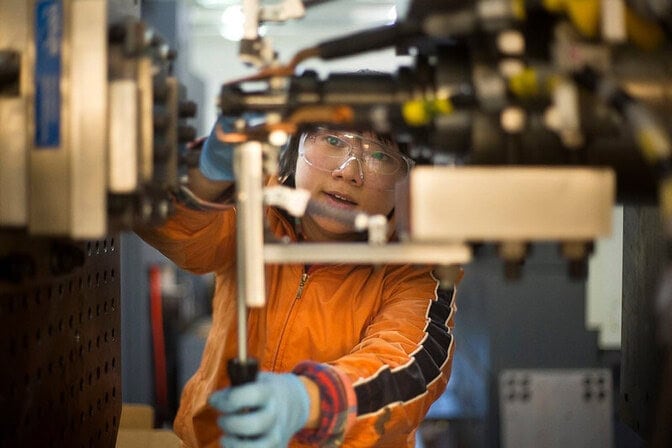
Advanced materials
Innovating in lightweight alloys, design-for-additive, circularity & characterization
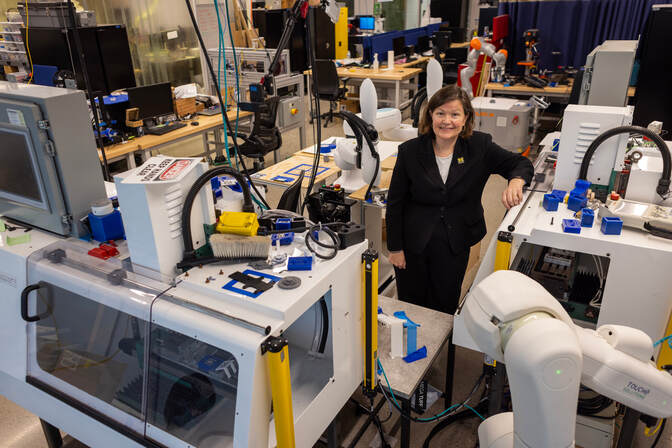
Digital & smart manufacturing
Harnessing AI, digital twins, cyber-physical systems and sensors
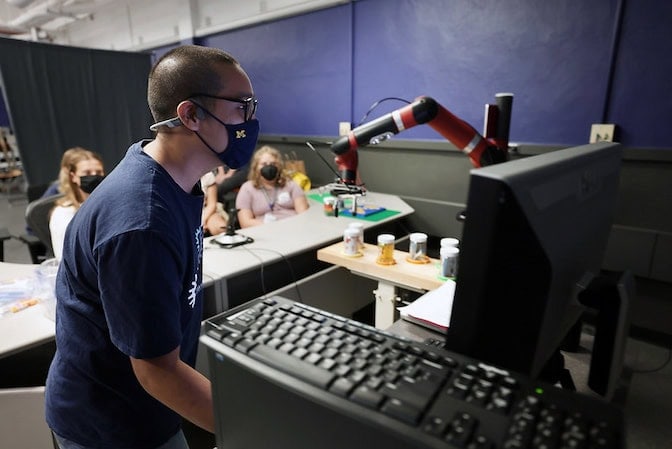
Human-autonomy teams
Developing efficient collaboration between humans and autonomous systems
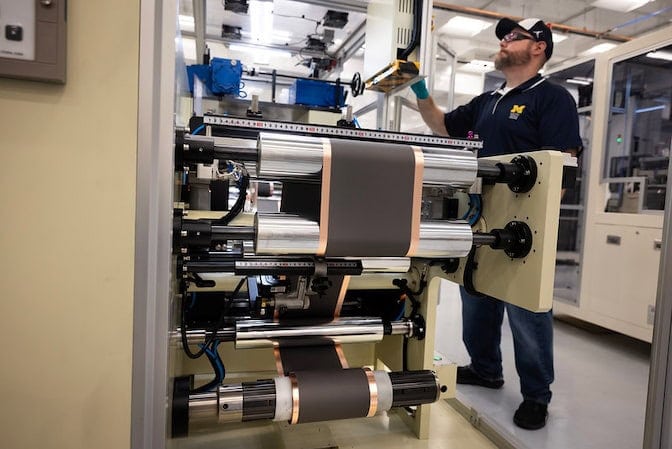
Optimizing systems & processes
Improving core processes and supply chains for performance and sustainability
In the News
WorkBoat
August 3, 2026
Report says Great Lakes-St. Lawrence positioned for shipbuilding expansion
Assembly
July 16, 2026
University of Michigan tackles industry 5.0 transformation
Battery Technology
October 27, 2025
Inside University of Michigan’s brand new battery lab

Technologies for a U.S. manufacturing renaissance
Former chief scientist of manufacturing at GM Global R&D Jeff Abell offers an industry veteran’s take on U.S. manufacturing and the university’s role.
$4.45M
investment to revamp U-M’s open manufacturing research lab.
A century of manufacturing leadership
The University of Michigan’s leadership in manufacturing stretches back more than a century. In 1921, U-M established the nation’s first Department of Production Engineering, founded by Orlan W. Boston. His early work helped lay the scientific foundations of modern manufacturing—from machining processes like turning and milling to pioneering research on metal machinability.
In the 1980s, the College launched the Center for Robotics and Integrated Manufacturing to help revitalize the state and nation’s industrial base. Bringing together six departments, the center united mathematics, control theory, and advanced statistics with manufacturing practice. Faculty including Yoram Koren, Sam Wu, and later Galip Ulsoy, Jack Hu and Jun Ni helped establish Michigan as a powerhouse in intelligent manufacturing systems. Their impact culminated in the NSF Engineering Research Center for Reconfigurable Manufacturing Systems—led by Koren— which transformed how engineers think about factory design and introduced modular, adaptable, scalable production lines.
University of Michigan Engineering’s influence in advanced manufacturing extends to national policy as well. Sridhar Kota played a central role in shaping U.S. advanced manufacturing strategy during his tenure at the White House Office of Science and Technology Policy (2009–2012). He helped launch the Advanced Manufacturing Partnership and was the driving force behind the creation of what became Manufacturing USA—a national network of institutes designed to bridge the gap between research and production and strengthen domestic supply chains. Michigan Engineers led by Alan Taub launched one of the Manufacturing USA institutes, Lightweight Innovations For Tomorrow (LIFT) in Detroit. Over the past decade, LIFT has grown to 340 member organizations and helped train 250,000 students, including adult learners.
50+ faculty
faculty in 10 departments conducting research connected to manufacturing.
In 2022, Michigan Engineering launched the first Robotics Department at a top-10 engineering school.
Facilities, institutes and programs
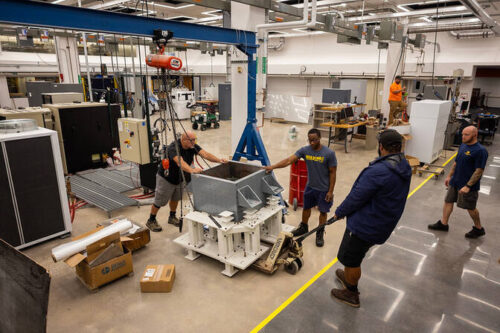
Open Manufacturing Lab
at 1100 HH Dow
Shared space with tools for advanced and conventional manufacturing plus a classroom.
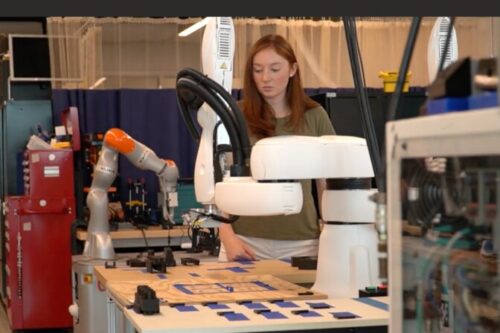
SMART 4.0 Testbed
A “connected factory” of mobile robots, computer-controlled machines (CNCs), additive and subtractive processing and more.
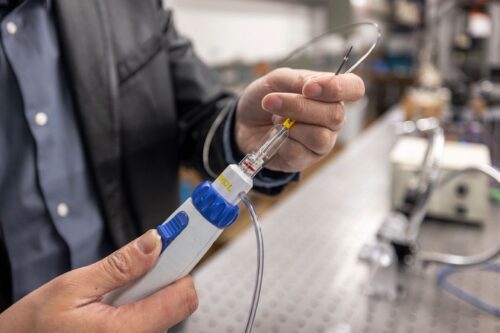
Biomedical Manufacturing and Design Lab
Leader in machining soft biomaterials, design and additive manufacturing of assistive devices and more.
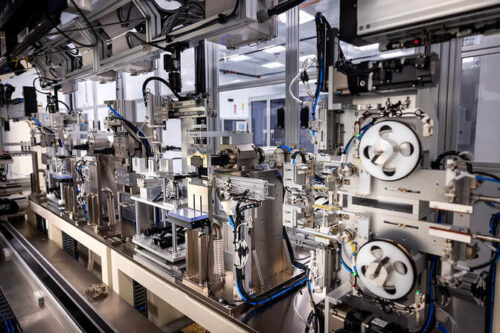
U-M Battery Lab
User facility offering the highest-capacity pilot line at a US university. Open to industry and researchers for IP-protected, scalable cell prototyping.
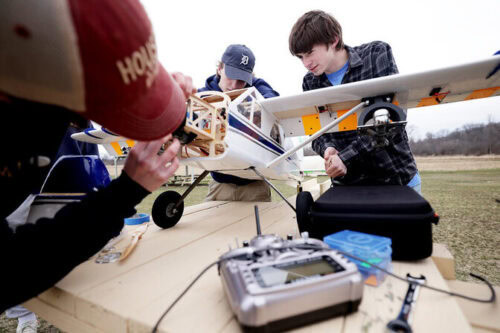
Model Based Systems Engineering Lab
For AERO students in our unique MBSE courses that include applying MBSE to manufacturing and feasible designs.
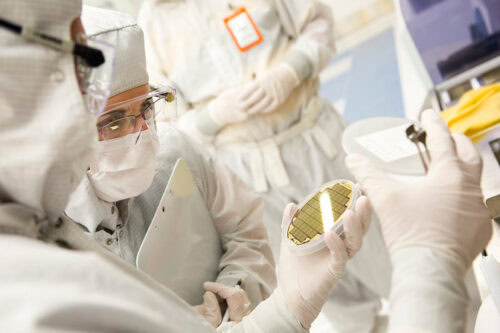
Lurie Nanofabrication Facility
A world-class cleanroom for prototyping advanced semiconductor devices, including implantable medical devices and sensors.
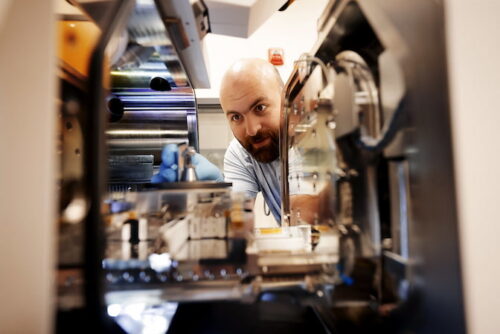
Michigan Center for Materials Characterization
User facility with state-of-the-art instruments for micron and nanoscale imaging and materials analysis.
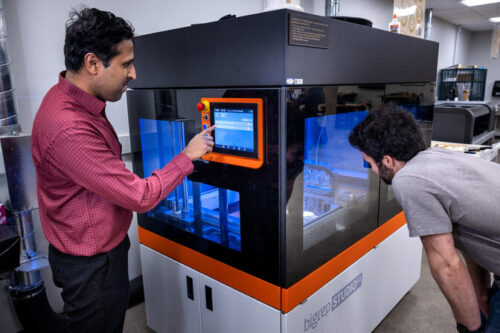
Fabrication Underground
A staffed prototyping studio and makerspace open to the U-M community, offering tools, 3D printers, a laser cutter, 3D scanners, and electronics workbenches.
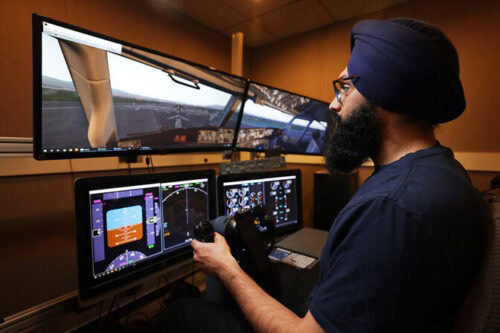
Center for Ergonomics
Distinguished in human factors engineering and ergonomics for 40 years. Founded by “the father of occupational biomechanics.
U-M Advanced Manufacturing Institute
Integrating engineering, behavioral science and organizational design for human-centered, resilient and sustainable manufacturing.
100+
patents in core manufacturing areas 2021-2025
Real-world impact through startups





Critical contributions
These major breakthroughs, partnerships and events have set the stage for ongoing success in advanced manufacturing innovation at Michigan.