Majors
What kind of engineer will you be?
University of Michigan Engineering offers 18 undergraduate majors leading to a Bachelor of Science degree, with hands-on opportunities that align with your specific interests and values. Explore your options, ask questions and make informed decisions. An engineering academic advisor can help you clarify your goals and choose a path that fits.
Explore majors
-
The science of flight divides into two branches: Aeronautics focuses on designing and studying aircraft within Earth’s atmosphere, while Astronautics deals with spacecraft design and study.
-
The application of the life sciences and engineering principles to bridge the gap between medical technology and medicine in practice.
-
The application of the natural sciences, math, and often coding to develop cost-effective and environmentally-friendly ways to produce materials medicines, and energy that can improve lives and the planet.
-
The design and construction of structures and systems that support everyday life, including buildings, bridges, and transportation networks, with a focus on safety, efficiency and long-term resiliency.
-
The study of the atmosphere, including its physical and chemical processes and characteristics.
-
The design and construction of computing systems from the hardware to the software to harness technology in new, productive, and surprising ways.
-
The theory and practice of how to design and analyze algorithms, how to store and retrieve information, how computers function, and how to develop software systems that solve complex problems.
-
A foundation in those aspects of computer science, statistics, and mathematics that are relevant for analyzing and manipulating large, complex datasets to create actionable knowledge.
-
The study of devices, circuits, signals & systems, electromagnetics, and programming, with additional expertise in electronics, power, control, communications, optics, and/or computers to solve problems in any field you choose.
-
A combination of strong physics education with an individually chosen engineering discipline.
-
The development of technologies and practices that protect public health and the environment, focusing on clean water, air quality, waste management and sustainable resource use.
-
The optimization of complex systems and processes by collaborating with people, analyzing data and drawing insights from a combined engineering and business mindset.
-
The investigation of how materials perform and why they fail so that we can create materials with unprecedented functions and properties.
-
A fundamental field of engineering that examines, designs, and creates solutions for anything that moves. Mechanical engineers work across all industries, from medical and energy to manufacturing and aerospace.
-
Naval architects handle design, stability, hydrodynamics, and performance, while marine engineers manage propulsion, power, and environmental systems. Careers span shipyards, design firms, offshore engineering, and marine research.
-
Nuclear Engineering & Radiological Sciences is the study of nuclear, radiological, and plasma processes to solve problems in energy, medicine, security and space.
-
The study of embodied intelligence for machines that sense, reason, act, and work with people to improve quality of life and productivity equitably across society.
-
The designing, building, operating, and analyzing data from instruments to explore the space environments of our Earth and other planets.









Level up
Enhance your undergraduate experience
Get your Master’s faster
Complete a Bachelor’s and Master’s degree in five years with Sequential Undergraduate Graduate Studies (SUGS).
Engineering minors
Engineering minors are an optional but often beneficial way to study beyond your major.
Dual Degrees
Learn about the eligibility criteria and deadlines for dual degree applications. Then talk to an academic advisor to make sure it’s the right academic path and fit.
Experiential Learning
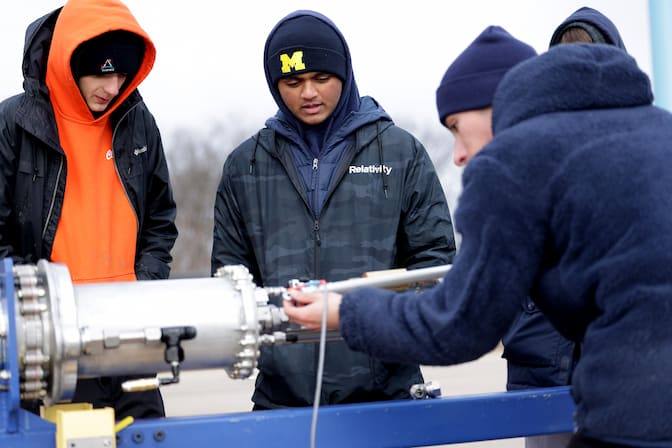
Connect with people, places and hands-on projects through our Immersed learning framework, a core part of the Michigan Engineering undergraduate experience.
Looking for courses?
The Course Guide and Bulletin is always the most up-to-date source for information on Michigan Engineering courses, curricula, and paths of study.